
Sub-sales and duty
You may have to pay duty on certain sub-sales of property.
Key information
The sub-sale provisions in the Duties Act 2000 (the Duties Act) provide that a transfer of property can attract 2 (or more) lots of duty if there is a sub-sale of the property, such as a nomination that involves additional consideration or land development.
Different rules apply to a transfer of property:
- that involves additional consideration or land development, or
- that results from an option involving additional consideration or land development.
Circumstances where the sub-sale provisions apply
Transfers involving additional consideration or land development
The sub-sale provisions apply to a transfer of property where:
- a person (the vendor) enters into a contract (the sale contract) to sell or transfer a property to another person (the first purchaser)
- a subsequent purchaser obtains the right (transfer right) to have the property (or any part of it) transferred to them, on completion of the sale contract (e.g. by nomination or otherwise)
- either of the following occurs:
- the subsequent purchaser or an associate gives or agrees to give additional consideration to obtain the transfer right, or
- land development occurs in relation to the property (or any part of it) between the contract date and transfer date, and
- the vendor transfers the property (or any part of it) to the subsequent purchaser.
Transfers resulting from options
The sub-sale provisions also apply to the transfer of land resulting from options where:
- a vendor grants an option to, or receives an option from, a person (a first purchaser) to enter into a contract of sale of the property or to transfer the property
- a subsequent purchaser obtains the right, or assumes the obligation, to enter into a sale contract or to have the property (or any part of it) transferred to them (a transfer right)
- either of the following occurs:
- the subsequent purchaser or an associate gives or agrees to give additional consideration to obtain the transfer right, or
- land development occurs in relation to the property (or any part of it) between the grant of the option and transfer date, and
- the vendor transfers the property (or any part of it) to a subsequent purchaser.
For the purpose of the sub-sale provisions, an option is broadly defined and includes a 'put option', 'call option' and 'put and call option' in their usual commercial sense.
A sub-sale is set out diagrammatically below:
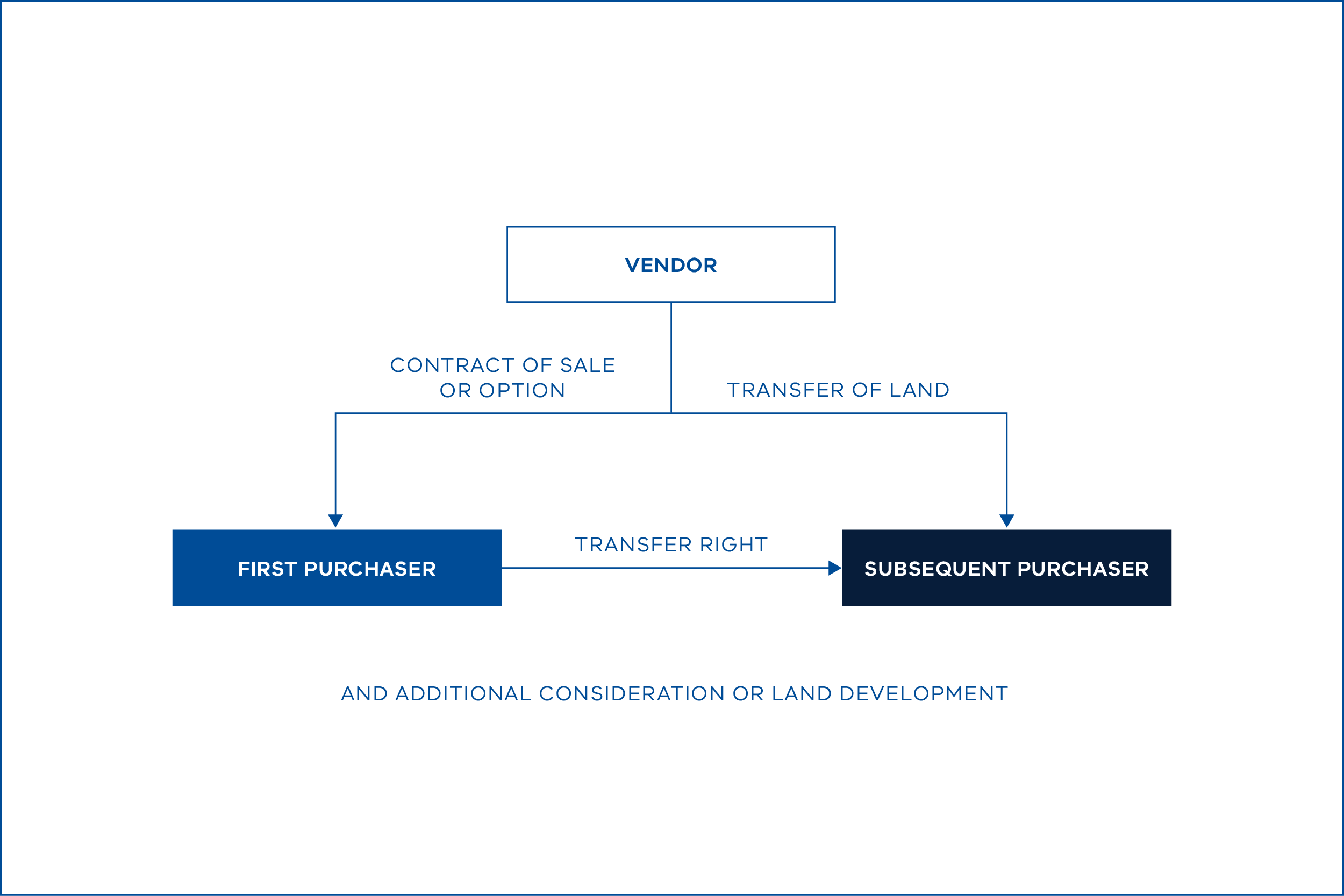
In certain cases, there may be multiple subsequent transactions and multiple subsequent purchasers, such as serial nominations.
Duty charged under the sub-sale provisions
Where the sub-sale provisions apply, a transfer of property attracts 2 (or more) lots of duty. Specifically, duty is charged separately on:
- the dutiable value of the sale contract or option, and
- the dutiable value of each subsequent transaction by which a subsequent purchaser obtains (or assumes) a transfer right (e.g. the nomination).
Liability for duty
Different purchasers are liable for duty under the sub-sale provisions:
- the first purchaser is liable for duty on the sale contract or option, and
- each subsequent purchaser is liable for duty on the subsequent transaction by which they obtain their transfer right.
Definitions and concepts
Transfer right
A person typically obtains a transfer right by nomination. However, a person may also obtain (or assume) a transfer right in other ways, including by assignment or novation of the sale contract or option. Importantly, a nomination (or other subsequent transaction) will not trigger the sub-sale provisions unless it involves additional consideration or land development.
Additional consideration
Generally, additional consideration to obtain a transfer right:
- includes monetary or non-monetary consideration that exceeds what the purchaser gave or agreed to give under the sale contract (or an earlier subsequent purchaser). For example, a nomination fee
- includes situations where there is a parallel land and building arrangement. Broadly, under these arrangements a first purchaser under the sale contract (e.g. a builder) sells the land to another person and, around the same time, enters into a separate contract with the person to build a home on that land. It does not matter whether the second separate contract is on arm’s length commercial terms or not
- excludes the reimbursement of certain costs, such as a deposit payable under the sale contract, legal costs, survey or valuation payments or reasonable selling agents’ fees.
Land development
Land development includes several key steps in the land development process, including applying for a planning permit in relation to the use or development of a property. It does not matter whether an application for a planning permit is successful.
Land development includes any one or more of the following actions:
- Preparing a plan of subdivision or taking any steps to have the plan registered.
- Applying for or obtaining a planning permit in relation to the use or development of the land.
- Requesting a planning authority to prepare an amendment to a planning scheme that would affect the land.
- Applying for or obtaining a building permit or approval in relation to the land.
- Doing anything in relation to land for which a building permit or approval would be required.
- Developing or changing the land in any other way that would lead to the enhancement of its value.
For guidance on the actions and activities which the Commissioner of State Revenue considers to constitute land development, see Revenue Ruling DA-064v2 – Meaning of land development.
If your circumstances are not covered in the ruling, consider requesting a private ruling.
Timing of land development and additional duty
The timing of land development (such as applying for a planning permit) and a nomination (or other subsequent transaction) determines whether land development triggers an additional duty liability. Generally, there are different duty outcomes depending on the timing of land development and the nomination date:
- If land development occurs before the contract or option date, no additional duty applies.*
- If land development occurs between the contract or option date and the nomination date, additional duty applies.**
- If land development occurs between the nomination date and the transfer date, no additional duty applies because an exclusion applies.*
* An additional duty liability may still arise if a subsequent purchaser or an associate gives or agrees to give additional consideration to obtain the transfer right.
** This is subject to any exemption or exclusion that applies (see below).
There are other situations where land development will not trigger a duty liability on a sale contract or option (or a subsequent transaction if there are serial nominations). These include situations where the consideration paid or agreed to be paid by the first purchaser under the sale contract or the option included consideration for the land development and the first purchaser (and their associates) did not undertake or participate in the land development at any time before the nomination date.
Exemptions and concessions
The sub-sale provisions include several exemptions and concessions that can apply to an additional duty liability arising under the sub-sale provisions. These include:
- an exemption from duty on a sale contract or option if a subsequent purchaser is either an individual (acting on their own behalf) who is a relative of the first purchaser or the trustee of a fixed trust whose only beneficiaries are individuals who are relatives of the first purchaser
- an exemption or concession from duty on a sale contract or option if a specified exemption or concession under Chapter 2 of the Duties Act would apply if the sale contract or option were a transfer of property to the first purchaser. Relevantly, these specified exemptions do not include exemptions relating to trusts or superannuation, such as the apparent purchaser duty exemption
- from 13 December 2023, an exemption or concession from duty on a sale contract, option, or subsequent transaction in certain circumstances where the transaction is eligible for a corporate reconstruction exemption or concession if it were a transfer of property between members of a corporate group.
Examples of common situations
The following examples illustrate how the sub-sale provisions apply to 3 common situations.