
Grouping for wagering and betting tax
Entities may be grouped if they share ownership or common control.
Key information
A wagering and betting group can arise through:
- related bodies corporate, such as holding and subsidiary relationships, or
- common control, where the same person or people have a controlling interest in more than one wagering and betting business.
A group can only claim one tax‑free threshold per financial year.
All members of a group are jointly and severally liable for wagering and betting tax, even if a member is not itself a wagering or betting entity.
Register for wagering and betting tax when you become liable. If you are already registered, update your details in the portal if your group arrangements change.
Related corporations
If corporations are related bodies corporate within the meaning of the Corporations Act 2001 (Cth), they are grouped under s41 of the Gambling Taxation Act 2023 (the Act).
This is usually called a holding/subsidiary relationship.
A corporation is grouped with another corporation if it meets one of the following conditions:
- It holds more than 50% of the issued share capital of the other corporation.
- It controls how the other corporation's board of directions is composed.
- It can cast or control more than 50% of the votes which can be cast at a general meeting of the other corporation.
For wagering and betting tax, a group includes:
- corporations in a direct holding/subsidiary relationship
- corporations with a common:
- holding company, or
- ultimate holding company.
Example: related corporations
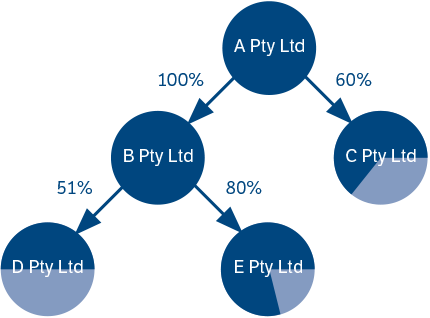
- A constitutes a group with both B and C. A is the holding company of both B and C because it holds more than 50% of the issued shares of each company.
- B, D and E constitute a group because B is the holding company of both D and E.
- All the companies constitute a group because A is the common ultimate holding company.
This provision will not be applied to group a corporation which only acts as a trustee of a trust and is not trading in its own right. This applies even though it forms a holding/subsidiary relationship with another corporation.
The grouping provisions apply to corporations regardless of where they are located. This is particularly relevant to Australian subsidiaries of an overseas parent corporation. Australian subsidiaries may be grouped even if they don't know the others exist.
A corporation owned by an overseas parent corporation should contact their parent corporation to work out whether there are other subsidiaries operating in Australia.
Common control through controlling interest
If a person or set of people has a controlling interest in each of 2 businesses, the entities that carry on those businesses make up a group, not the persons who have the controlling interest.
For wagering and betting tax, 'business' means the business of a wagering and betting entity, whether carried on by one person or 2 or more persons together.
What constitutes a controlling interest depends on the type of entity operating the business. Under s42 of the Act, a person or a set of persons is considered to have a controlling interest:
- Where a business is conducted by a corporation, that person or set of persons:
- is the director of that corporation and can exercise more than 50% of the voting power at a directors’ meeting,
- can instruct or influence a director(s) who can exercise more than 50% of the voting power at a directors’ meeting, or
- can exercise or influence the exercise of more than 50% of the voting power attached to any class of issued voting shares of the corporation.
- Where a business is conducted by a partnership, that person or set of persons:
- owns, beneficially or not, more than 50% of the capital of the partnership, or
- is entitled, beneficially or not, to more than 50% of the profits of the partnership.
- Where the business is conducted by one person, that person is the sole owner of the business.
- Where, a set of persons are together, as trustees, the sole owners of the business.
- Where a business is conducted by a trust, that person or set of persons is the beneficiary of more than 50% of the value of the interests in the trust.
In relation to trusts:
- interests in a trust include, entitlements to profits or capital distributions, among other things
- any person who may benefit from a discretionary trust is deemed to be a beneficiary of more than 50% of the value of the interests in the trust and therefore has a controlling interest in that trust.
Common control through indirect relationships
For the purposes of the grouping provisions, a controlling interest does not need to be direct. Control may be held through another entity to which a person is related or in which a person has a controlling interest. This can occur in the following 3 ways.
Control through related corporations
If corporations are related under s50 of the Corporations Act 2001 (Cth), a corporation is deemed to have a controlling interest in any business in which a related corporation has a controlling interest.
Example: control through related corporations
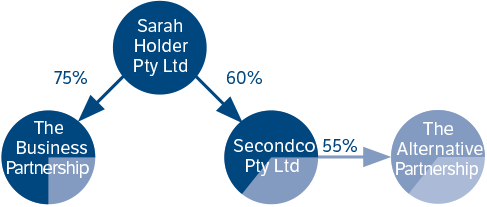
Sarah Holder Pty Ltd and Secondco Pty Ltd are related under s50 of the Corporations Act 2001 (Cth) because Secondco Pty Ltd is a subsidiary of Sarah Holder Pty Ltd. These 2 companies have controlling interests in 2 businesses, The Business Partnership, and The Alternative Partnership.
As Sarah Holder Pty Ltd and Secondco Pty Ltd are related, Sarah Holder Pty Ltd is deemed to have a controlling interest in the business in which Secondco Pty Ltd has a controlling interest (i.e. The Alternative Partnership). Therefore, The Business Partnership and The Alternative Partnership constitute a group. This is because Sarah Holder Pty Ltd has a controlling interest in The Business Partnership and is deemed to have a controlling interest in The Alternative Partnership.
Control through an entity that carries on another business
If a person has a controlling interest in one business and the person who carries on that business has a controlling interest in another business, then that first person is also deemed to have a controlling interest in the second business.
Example: control through an entity that carries on another business

Ian Vestor has a controlling interest in Business A. Company A, which carries on Business A, has a controlling interest in Business B. This means Ian Vestor is deemed to have a controlling interest in Business B via his controlling interest in Business A.
Control through a trust beneficiary
Where a trustee of a trust has a controlling interest in a business (whether carried on by another trust, a corporation or a partnership), a beneficiary of that trust will be deemed to have a controlling interest in that business if that beneficiary is a beneficiary in respect of more than 50% of the value of the interests in that trust.
Example: control through a trust beneficiary

Trustee Co. Pty Ltd has a controlling interest in a business carried on by Trading Co. Pty Ltd. Ben Robinson stands to benefit from the Robinson Family Discretionary Trust. That means he is deemed to be a beneficiary of more than 50% of the value of the interests in that trust. As such, he is deemed to also have a controlling interest in the business carried on by Trading Co. Pty Ltd.
Smaller groups subsumed by larger group
When a person is a member of 2 or more groups, all the members of these groups constitute one group for wagering and betting tax purposes.
This can be called an amalgamation of groups.
If 2 or more members of a group have a controlling interest in a business together, all the members of the group and the people carrying on the business together constitute a group.
No discretion to degroup
Unlike payroll tax, we do not have discretion to exclude any member from a wagering and betting group.
Leaving or joining a group
The tax-free threshold is an annual threshold. So special grouping rules apply when an entity leaves or joins a group during a financial year.
Joining entity
When a tax-paying entity becomes a member of a group, the group's tax-free threshold will be reduced to zero.
When a non-tax-paying entity becomes a member of a group, the group's tax-free threshold will remain unchanged. Net wagering revenue collected by that entity before joining the group that financial year is added to the group's net wagering revenue.
Leaving entity rule
When a group member leaves a group, the leaving entity's tax-free threshold for the rest of the financial year will be reduced down to zero by its net wagering revenue while it was still part of the group.
Moving groups
When an entity moves from a tax-paying group (Group 1) to another group (Group 2) during a financial year, Group 2's tax-free threshold will be reduced to zero. The net wagering revenue collected by that entity while it was a member of Group 1 during the financial year will be transferred to Group 2’s net wagering revenue.
When an entity moves from a non-tax-paying group (Group 1) to another group (Group 2) during a financial year, the tax-free threshold for Group 2 will remain unchanged. Then net wagering revenue collected by that entity while it was a member of Group 1 during the financial year will not be transferred to Group 2’s net wagering revenue.
Breaking into smaller groups
Where a tax-paying group breaks into multiple smaller groups during a financial year, each of the smaller groups' tax-free threshold is reduced to zero. The net wagering revenue collected by each member while it was a member of the big group in that financial year will not be transferred into the smaller groups' net wagering revenue.
Where a non-tax-paying group breaks into multiple smaller groups during a financial year, each smaller group is entitled to a $1,000,000 tax-free threshold. The net wagering revenue collected by each member while it was a member of the big group in that financial year will be transferred into the smaller groups’ net wagering revenue.