
Relevant acquisitions
How a relevant acquisition can occur.
Key information
Landholder duty applies when a relevant acquisition is made in a landholder. A relevant acquisition is made when a person acquires:
- a significant interest or a further interest in a landholder
- an economic entitlement in a private landholder
- control over a private landholder.
A relevant acquisition can also occur when a private landholder is converted to a public landholder.
If a relevant acquisition is made in a landholder, an acquisition statement must be completed and lodged, and duty paid within 30 days of the date of the relevant acquisition.
To understand key terms used on this page, see landholder definitions.
Relevant acquisition of a significant interest
A relevant acquisition of a significant interest is made in a landholder when a person acquires an interest:
- that is, of itself, a significant interest, being an interest of:
- 20% or more in a private unit trust scheme
- 50% or more in a private company or a wholesale unit trust scheme
- 90% or more in a listed company or a public unit trust scheme
- that, when aggregated with other interests acquired by the person, an associated person or any other person in an associated transaction, amounts to a significant interest in the landholder.
For more information, refer to:
- sections 78(1)(a), 78(5) and the transitional provisions in clause 31(2) of schedule 2 of the Act
- Revenue Ruling DA-057v2 – Meaning of associated transaction.
Relevant acquisition of a further interest
Once a relevant acquisition of a significant interest has been made by a person in a private landholder, all subsequent interests acquired by that person or an associated person will be a relevant acquisition of a further interest. Where the relevant acquisition of the significant interest involved the aggregation of interests acquired by persons under an associated transaction, all subsequent interests acquired by those persons will also be a relevant acquisition of a further interest.
Where a relevant acquisition of a significant interest has been made by a person in a public landholder, no duty is chargeable on any further interests acquired by that person in the landholder.
For more information refer to sections 78(1)(b) and 87(3) of the Act.
Relevant acquisition of economic entitlement in a private landholder
A person can make a relevant acquisition in a private landholder if they acquire an economic entitlement of 50% or more within a 3-year period. This applies if the person acquires, either alone or together with an associated person, directly or indirectly, an economic entitlement other than by way of a relevant acquisition dutiable under Part 2 of Chapter 3 of the Act.
A person acquires an economic entitlement if they acquire shares or units in a private landholder or enter into an arrangement relating to a private landholder under which they are entitled to:
- participate in the dividends or income of the private landholder
- receive any amount determined by reference to the dividends or income of the private landholder
- acquire any entitlement described above.
Where a person acquires an economic entitlement that amounts to an interest of 50% or more, the person is taken to have made a relevant acquisition of that percentage interest in the landholder, unless the Commissioner determines a lesser percentage interest is appropriate in the circumstances.
If duty is payable on the acquisition of the economic entitlement, it is calculated by reference to the unencumbered value of the landholder’s land holdings in Victoria at the time the economic entitlement was acquired.
For more information, refer to section 81 of the Act.
Examples of the application of the economic entitlement provisions follow:
Example 1: Share acquisition
A person acquires a class of shares in a private company landholder that entitles the person to 100% of the dividends of the landholder. The shares do not carry any entitlement to a distribution of property on a winding up of the landholder. However, the shares do carry the right to compel a sale of the landholder’s land holdings before a winding up of the landholder. If this right of sale is exercised, the proceeds of sale will be paid to the person as a dividend.
In these circumstances, the person will be regarded as having acquired an economic entitlement, being the right to the dividends of the landholder. As the person has acquired 100% of this economic benefit, the person is taken to have made a relevant acquisition of 100% in the landholder.
Example 2: Dividend linked notes
A private landholder comprising a farmer’s co-operative owns significant land in Victoria. It wishes to raise capital from the public for substantial investment in its processing capabilities so that it can meet growing demand from overseas markets. Due to its nature as a co-operative, the landholder is unable to undertake a public capital raising and list on the ASX. As an alternative, it has decided to float a wholly owned unit trust on the ASX. It intends to issue notes that entitle the trust to receive payments whenever the landholder declares a dividend.
Under the arrangement, each time the landholder declares a dividend, the trust will be entitled to receive a payment equal to the total dividends payable to shareholders. This effectively gives the trust a right to 50% of the profits/dividends available for distribution to shareholders. Other than this entitlement, the notes will not entitle the trust to participate in a distribution of property on a winding up of the landholder and will not carry any voting rights.
Under this arrangement, the trust is regarded as having acquired an economic entitlement as the notes entitle the trust to participate in the dividends of the landholder and/or to receive an amount determined by reference to such dividends. Given the notes entitle the trust to effectively receive 50% of the profits/dividends available for distribution to shareholders, the trust is taken to have made a relevant acquisition of an equivalent 50% interest in the landholder.
Relevant acquisition on acquiring control over a landholder
If a person acquires control, either directly or indirectly, over a private landholder within a 3-year period, other than by a relevant acquisition dutiable under Chapter 3, then on acquiring that control the person is taken to have made a relevant acquisition of an interest in the landholder. The relevant acquisition is taken to be an interest of 100%, unless the Commissioner determines otherwise. A person may be considered to have acquired control over a landholder if they acquire the capacity to determine or influence the outcome of decisions about the landholder's financial and operating policies.
The control provisions can only apply where control is acquired other than by way of a relevant acquisition dutiable under Part 2 of Chapter 3 of the Act. This includes a relevant acquisition of an economic entitlement. The purpose of the control provisions is to ensure arrangements that provide for the ultimate control of a landholder are also taxable as relevant acquisitions. As a result, the provisions are capable of bringing to duty the indirect acquisition of a subsidiary company or sub trust through the direct acquisition of the parent entity.
The provisions can also apply to a person who is appointed to the board of directors of a landholder or the corporate trustee of a landholder. If shareholders or unit holders have not made arrangements that allow the director to benefit, or exercise rights which confer benefits similar to holding an interest in the landholder, the Commissioner will take the view that the director has not acquired control. In these circumstances, the director is not taken to have made a relevant acquisition of an interest of 100%.
For more information, refer to section 82 of the Act.
Other possible applications of the control provisions follow:
Example 1: Unlimited and irrevocable power of attorney
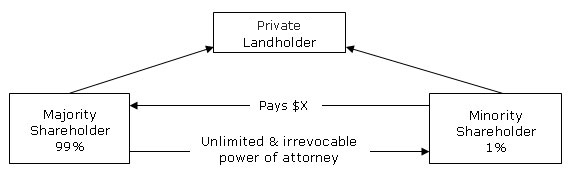
In this example, the majority shareholder of a private company grants for valuable consideration an unlimited and irrevocable power of attorney over the rights attaching to its shares in the company to a minority shareholder.
There is an understanding that the majority shareholder will remain registered as a shareholder of the landholder but that the minority shareholder will use the power of attorney over the voting rights attaching to the shares to its advantage.
In such circumstances, the minority shareholder will be considered to have acquired control of the landholder and have made a relevant acquisition of an interest of 99%.
Example 2: Private unit trust scheme
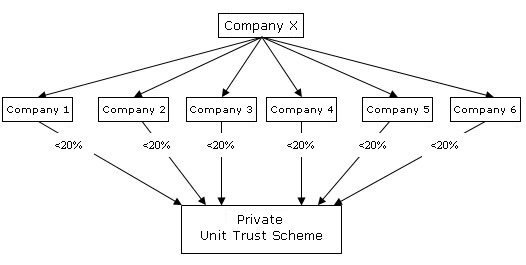
In this example, Company X acquires all the issued share capital of the 6 private companies that together own and control a landholder, being a private unit trust scheme. As each company's interest in the unit trust scheme is less than 20%, none of the companies can be considered a landholder under the constructive ownership provisions of the Act.
Consequently, Company X’s acquisition of all the issued share capital in each company would not give rise to a relevant acquisition. However, by acquiring all the shares in each of the companies that own and control the unit trust scheme, Company X has indirectly gained control over the scheme.
As a result, Company X is considered to have made a relevant acquisition of an interest of 100% in the unit trust scheme.
Relevant acquisition on the conversion of a private landholder to a public landholder
A relevant acquisition also arises if, under an agreement or arrangement, a landholder that is a private unit trust scheme, a wholesale unit trust scheme or private company becomes, through whatever means, a public unit trust scheme or a listed company.
All acquisitions of interests made under the agreement or arrangement are treated as a single acquisition of 100% in the public unit trust scheme or listed company. The relevant acquisition is taken to have been made on the date that the private unit trust scheme or wholesale unit trust scheme became a public unit trust scheme or the private company became a listed company. Duty is charged at 10% of the duty that would be chargeable on a transfer of all the land holdings of the landholder in Victoria. The calculation is based on the unencumbered value of the land holdings at the date of the relevant acquisition.
For more information, refer to sections 89B and 89C of the Act.